
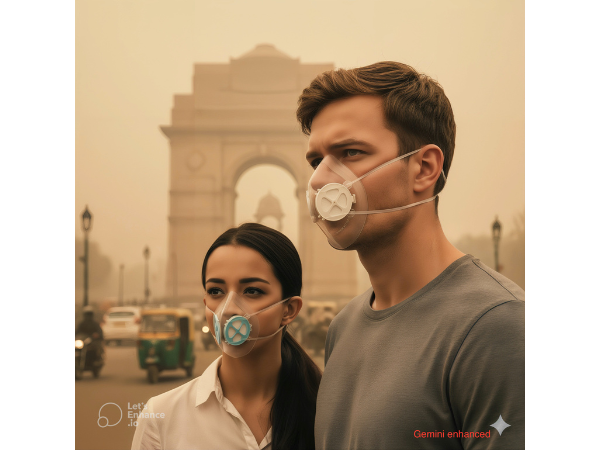
Delhi/Mumbai/Bengaluru: As the capital’s AQI again breaches the ‘Severe’ 400+ mark, a new study provides concrete data for millions seeking protection. Research from Queen Mary University of London, simulating Indian urban traffic, finds the reusable Totobobo mask reduces exposure to harmful black carbon (diesel soot) by an average of 71%—significantly outperforming other common masks.

KEY DATA FOR INDIAN CONTEXT:
- 71% Average Reduction: In roadside tests alongside buses and trucks, Totobobo filtered 71% of black carbon, a key toxin in Delhi/Bengaluru’s air linked to heart and lung disease. [Study Link]
- Superior Fit, Proven Protection: A separate peer-reviewed study from Hong Kong Prince of Wales Hospital confirmed the Totobobo mask is 75% more likely to fit a user than a typical N95 mask, directly addressing the #1 cause of protection failure in real-world use. [Study Link]
- The Visual Proof: In AQI 400+ conditions, the white filters turn grey within hours, visually capturing the PM2.5 and soot otherwise inhaled.
- An Investment That Lasts: The reusable mask is built for years of use. With affordable filter replacements, its cost-per-use becomes unbeatable versus weekly
- User-Endorsed Comfort: The customizable fit eliminates glasses fogging and eases breathing during hour-long commutes—critical for adoption in India’s humid climate.
Why This Study Matters for Indian Cities:
The Queen Mary University research, conducted in heavy London traffic, was a direct proxy for commutes in heavy traffic pollution such as Delhi NCR, Bengaluru, and Mumbai. “Many masks perform well in labs, but real-world fit-performance is not clear.” notes the study lead. For Indian commuters—on bikes, autos, or walking—real-world performance is paramount, the fit-factor conclusively validated by the Hong Kong study.
The “Fit Factor” Solved for Indian Faces:
The mask features a unique moldable and trimmable transparent shell that users can custom-fit, eliminating gaps around the nose and cheeks that plague standard disposables. This directly tackles the flaw reported by most Indian users of disposable N95s, turning a public health recommendation into a practical, wearable solution.
Long-Term Real-World Use in Delhi
In addition to controlled studies, long-term user experience offers insight into durability under Indian conditions.
Mohit, a resident of New Delhi, reports using the same reusable mask design continuously for over ten years, across multiple severe pollution seasons. In a publicly available video testimonial, he describes consistent fit, sustained comfort, and continued usability during daily exposure to traffic pollution.
While individual experiences do not replace clinical evidence, long-term use cases highlight the importance of durability and sustained performance when pollution exposure is recurrent rather than episodic.

Public Health Context
While reducing pollution at the source remains essential, experts emphasize that exposure-reduction measures can play a meaningful role in protecting vulnerable populations, including children, older adults, outdoor workers, and individuals with asthma or chronic respiratory conditions.
With disposable masks requiring frequent replacement and generating significant plastic waste during pollution seasons, reusable alternatives are increasingly being examined as part of broader risk-reduction strategies in polluted urban environments.
About the Studies
- Queen Mary University of London Study: Real-world comparison of multiple mask types using portable black carbon monitors during roadside traffic exposure.
Published in Thorax (British Thoracic Society).
https://thorax.bmj.com/content/72/Suppl_3/A162.2 - Hong Kong Prince of Wales Hospital Study: Peer-reviewed clinical evaluation of mask fit, leakage, and breathing comfort during prolonged wear.
https://journals.sagepub.com/doi/10.1177/15280837221123061
Media Contact:
Francis Chu | Founder francis@totobobo.com | Website